
June 14, 2026 · The Wolves Desk
The 45-day rule: why 'late' is the norm on Capitol Hill
The law builds in a lag, a chunk of Congress misses even that, and the fine is $200. Here is how to read timestamps like a professional.
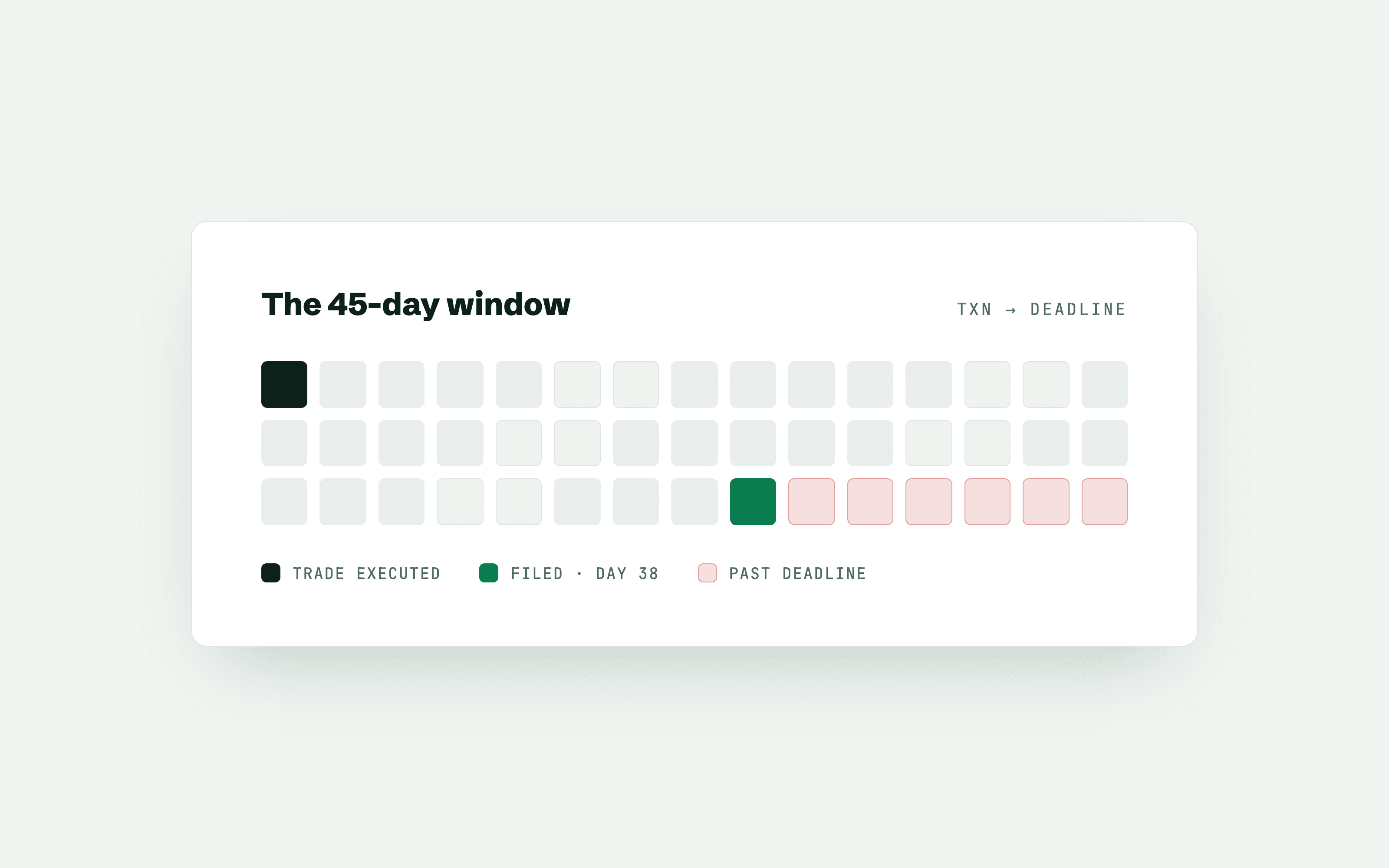
The most misunderstood thing about congressional trading data is time. People see a trade “from today” and assume the member traded today. Almost never. Every trade on the tape carries two dates — and the gap between them is where all the nuance lives.
The lag the law allows
Under the STOCK Act, a member must report a transaction within 30 days of becoming aware of it, and no later than 45 days after it happened. That means a fully compliant, entirely by-the-book filing can describe a trade made six weeks ago. This is not a loophole and not a scandal; it is the statute. No data vendor can shrink it — anyone promising trades “as they happen” is selling you something the law does not produce.
The lag the law does not allow
Then there is actual lateness. Tallies by newsrooms and watchdogs have found roughly 14% of members violating the STOCK Act’s deadlines — filings that land months, occasionally years, after the trade. The standard penalty is a $200 late fee, often waived. When the potential upside of a well-timed trade is measured in thousands or millions, $200 is not a deterrent; it is a rounding error.
Late filings also cluster in patterns regular readers of the tape learn to expect: batches of old trades surfacing at once, corrections filed as amendments, and the beloved Friday-evening dump, where awkward disclosures arrive after the news cycle has gone home.
Reading the tape like a professional
- Always read both dates. The transaction date tells you what the member did; the filing date tells you when the public was allowed to know.
- Watch the spread. Filing-minus-transaction is a behavioral signal in its own right. We compute it on every trade and track per-member punctuality.
- Treat amendments as history, not overwrites. When a filing is amended, we version the change — the original claim is part of the record too.
What "minutes" means here
Our latency promise covers the one segment anyone can control: from the moment a disclosure appears on the House Clerk or Senate eFD to the moment it is on your dashboard, in your webhook, in your inbox. That segment we hold to minutes, around the clock. The other 45 days belong to Congress — and the gap itself is data. We publish that too.
Want the data behind the story?
Every congressional trade, minutes after filing — dashboard, API, webhooks, and alerts.