
June 30, 2026 · The Wolves Desk
How congressional trading disclosures actually work (STOCK Act 101)
Who has to file, what a PTR contains, why amounts are ranges, and where the documents actually live.
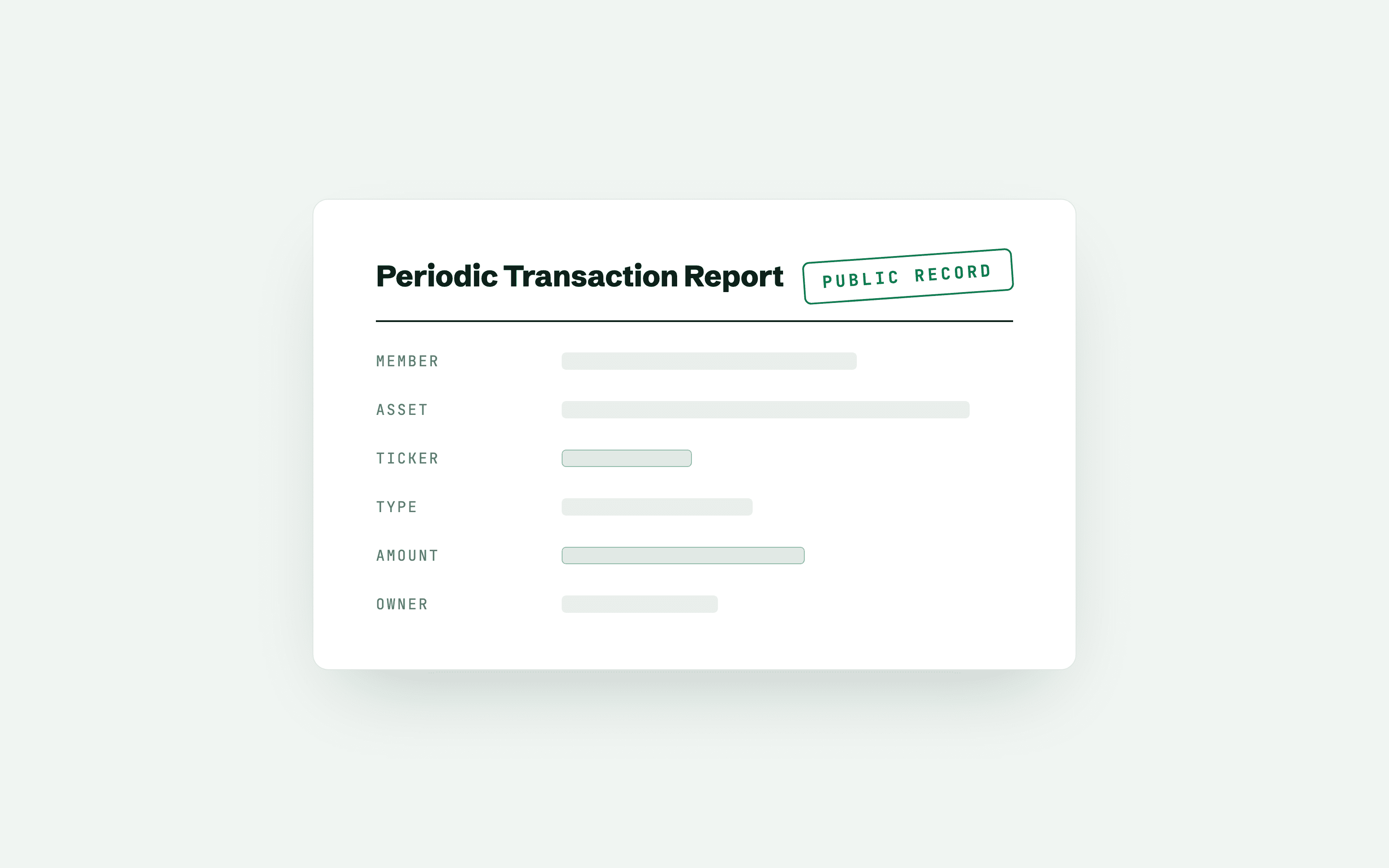
Every trade on our tape starts life as a government document. If you want to use congressional trading data well — as signal, as journalism, or as accountability — it pays to understand the machine that produces it. Here is the whole thing, without the mythology.
The law
The STOCK Act (Stop Trading on Congressional Knowledge Act, 2012) did two big things: it affirmed that members of Congress and their staff are not exempt from insider-trading law, and it required rapid public disclosure of their securities transactions. The disclosure vehicle is the Periodic Transaction Report, or PTR.
A member must file a PTR within 30 days of becoming aware of a covered transaction, and in no case later than 45 days after the transaction date. Covered transactions are purchases, sales, and exchanges of stocks, bonds, and other securities over $1,000 — and crucially, not just the member’s own: trades by a spouse, a joint account, or a dependent child must be disclosed too, tagged with an owner code. A spouse’s NVDA purchase is every bit as much a filing as the member’s.
What a PTR actually contains
- The asset, as free text. Not a ticker — a description, like “NVIDIA Corporation - Common Stock.” Sometimes clean, sometimes not. (That is a whole story of its own — see our piece on missing tickers.)
- The transaction type and date — purchase, sale (full or partial), or exchange, with the date it happened.
- An amount range, never an exact value. The buckets run from $1,001–$15,000 at the bottom through $15,001–$50,000, $50,001–$100,000 and upward to a top bucket of over $50,000,000. The law asks for the bucket, so the bucket is all anyone has.
- The owner — self, spouse, joint, or dependent child.
Where the documents live
House PTRs are published by the Clerk of the House financial-disclosure system; Senate filings go through the Senate eFD (electronic Financial Disclosure) portal. Two systems, different formats, different quirks — the Senate side still receives some filings on paper, which surface as scanned images. Disclosure archives reach back to 2008, with PTRs flowing steadily since the STOCK Act took effect in 2012.
Enforcement, such as it is
Miss the deadline and the standard penalty is a $200 late fee — the price of a decent dinner in the District. Analyses and newsroom tallies have found on the order of 14% of members violating the filing deadlines. The disclosure regime is real and legally binding, but its teeth are modest; the practical enforcement mechanism is publicity, which is roughly where we come in.
Everything we publish is built on this machinery: we watch both filing systems continuously, parse each PTR the moment it appears, and keep the source document linked to every trade. The record is public by law. Our job is making it usable within minutes.
Want the data behind the story?
Every congressional trade, minutes after filing — dashboard, API, webhooks, and alerts.